
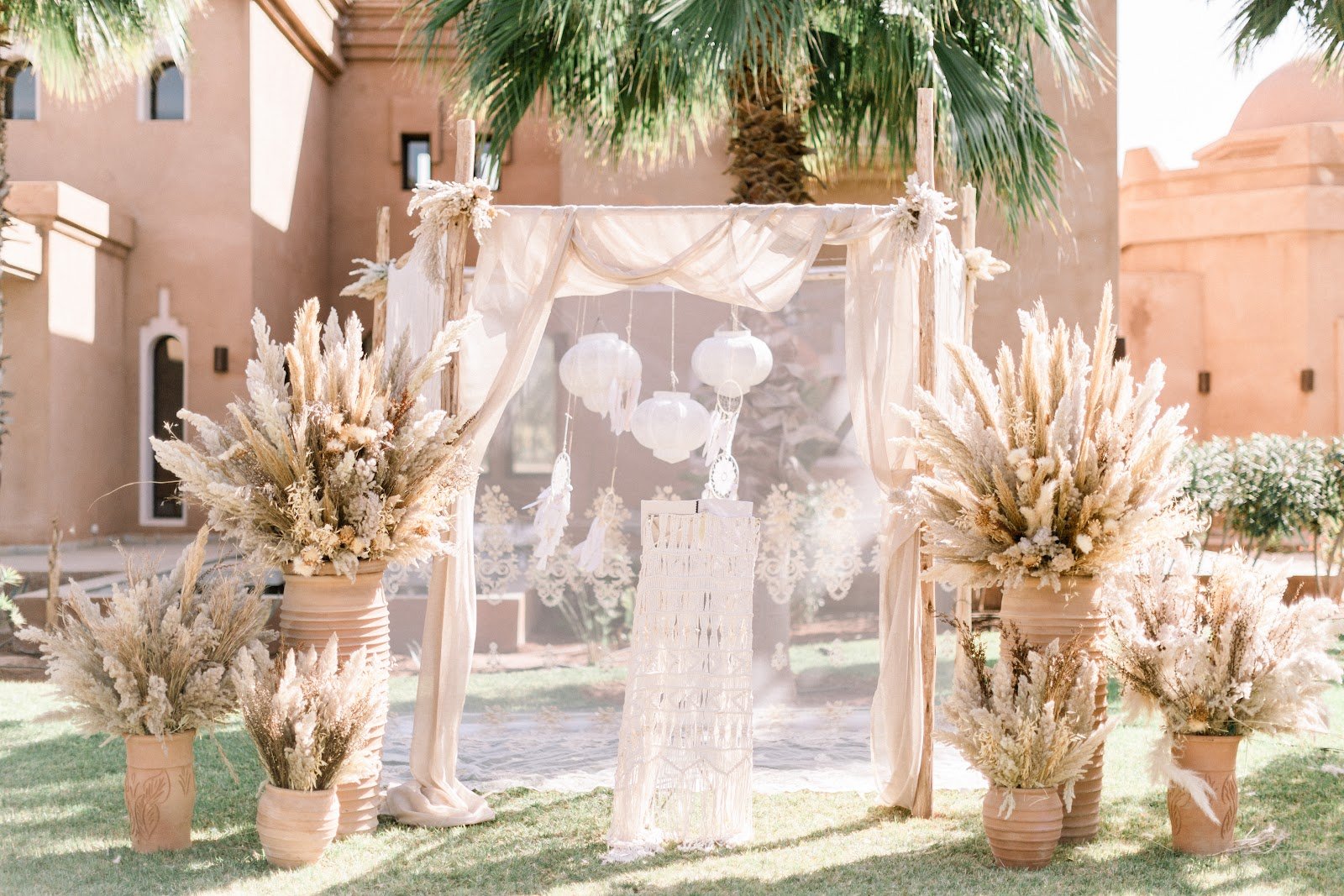
The flowers you imagine, and the flowers that grow here
Most couples arrive with a reference image, and the reference image was photographed in Provence or in the English Home Counties. Peonies, garden roses, hydrangea, ranunculus, a palette built for a temperate climate and a long, mild spring.
Morocco is not that climate. Some of those flowers can be imported, at a cost and with a risk. Others will simply not survive the day. And the more interesting fact, which takes a conversation to reach, is that the local alternatives are usually better suited to the light, the heat and the architecture they are standing in. A wedding planner in Marrakech will have this conversation early, because the answer changes the budget and the look at the same time.
What is genuinely in season
Spring, from March to May, is the richest period. Roses come from the Dadès valley, where the harvest runs through April and May and where the varieties are smaller, more heavily scented and far more resilient than imported garden roses. Bougainvillea is everywhere, in magenta, coral and white, and it is structural rather than delicate, it holds shape across a long hot day. Citrus blossom is in the air from March, and orange branches in fruit make an arrangement that is unmistakably of this place.
Summer narrows the palette and rewards restraint. Olive and eucalyptus branches, palm, pampas, dried grasses, and heat-tolerant flowers in smaller quantities. This is the season in which Moroccan weddings often look their best, because the constraint pushes the design towards texture and green architecture rather than mass.
Autumn brings a second, smaller rose season and the return of reliable cut flowers as the temperature drops. Winter is the leanest for local growing, and also the easiest for imports to survive the journey and the day.
The heat, which is the whole problem
A flower that is perfect at nine in the morning can be finished by four in the afternoon. This is not a matter of quality; it is physics. Anything with a soft head and a high water content, peony, hydrangea, most garden roses, is at risk in anything above thirty degrees, and it is at serious risk if it is standing in sun.
The practical consequences are unglamorous and they decide the outcome. Arrangements are built in shade and moved late. Ceremony flowers go out in the final hour, not the morning. Anything that must last the full day is chosen for structure, branches, succulents, dried material, bougainvillea, and the delicate work is reserved for the tables, which are set after the sun has gone.
Couples are frequently told none of this, and then spend the cocktail hour watching an arch wilt. Planning a wedding in Marrakech in June with a June palette from a Sussex florist’s mood board is the most common and most avoidable disappointment in the calendar.
Importing, honestly
It is possible. Flowers arrive from the Netherlands and from Kenya several times a week, and for a specific variety that matters to a couple it is often worth doing. What it requires is an honest account of three things: the cost, which is significant; the lead time, which is not flexible; and the fact that a shipment can be delayed, which means the design needs a fallback that is not humiliating.
The version that works is usually a hybrid, local material for volume and structure, a small quantity of imported stems for the bouquet and the top table, where they will be seen closely and where they only have to last the evening.
Beyond flowers
The most Moroccan decorative choices are frequently not floral at all. Citrus fruit in bowls. Rose petals loose on stone. Mint in glass. Lanterns, which do more for an evening than any centrepiece. Zellige tilework, which is already patterned and asks for very little on top of it.
A riad courtyard or a palace hall is not an empty room waiting to be decorated. It is already decorated, elaborately, by craftsmen who spent months on it. The restraint to leave it largely alone is the hardest instruction to give a visiting florist and the easiest way to make a celebration look as though it belongs where it is standing.
The question to ask first
Not what do I want, but what will still be alive at nine o’clock. Ask it of every element. The answers will reduce the list, and they will push what remains towards the material that grows here, which is what a wedding planner in Marrakech would have proposed at the outset, which is, almost always, what the photographs you loved were reaching for in the first place.