
Morocco is not one destination
Couples who decide on Morocco usually mean Marrakech, and often they are right. But the country offers at least four quite different weddings, and the distance between them, in climate, in atmosphere, in what they cost and what they demand, is much larger than the map suggests. It is worth knowing what the alternatives are before settling, if only to understand what you are choosing.
Marrakech
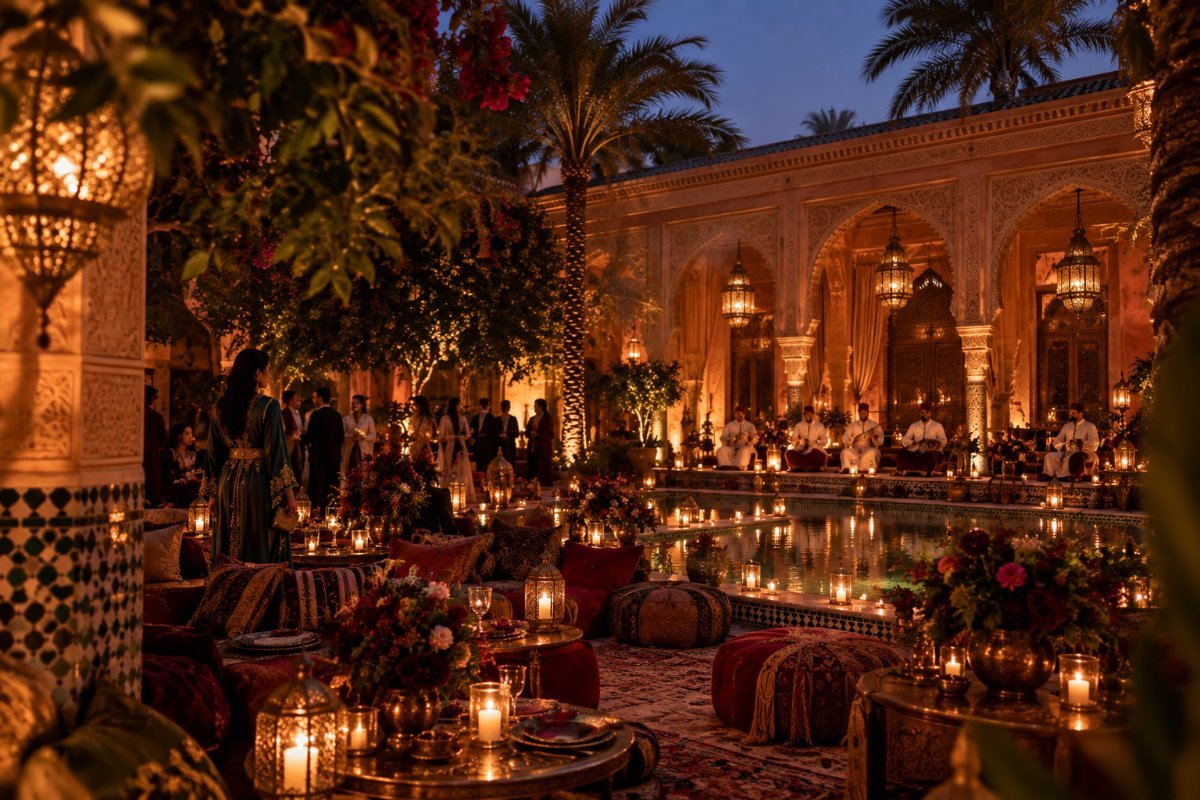
The default, and the default for reasons. It has the infrastructure: an international airport with direct flights from most of western Europe, hotels at every level, and, the part that matters most, a deep professional network. Florists who work weddings weekly. Sound engineers who have powered a band in a garden with no mains supply. Lantern makers, zellige masters, musicians whose families have played celebrations for generations.
It also has the range. Within forty minutes of the medina you can hold a wedding in a courtyard house, a palace, an olive grove, a Palmeraie estate or a stone desert. No other Moroccan city offers that spread, and it is why most couples who consider the alternatives return here. A wedding planner in Marrakech is working with the largest supplier base in the country, and on a day when something fails, that depth is what rescues it.
The cost is that it is busy, it is hot in high summerand the best venues are taken a year ahead in spring. Those are real constraints, and a wedding planner in Marrakech will raise them before you fall in love with a date.
Essaouira
Three hours west, on the Atlantic. Everything about it is different. The wind blows almost constantly, which is why the kitesurfers come and why the temperature in August is twenty degrees cooler than inland. The old town is small, white and blue, Portuguese-walled, and considerably more relaxed than Marrakech.
For a summer wedding it solves the heat problem completely. For every other season it introduces a different one: the wind is not occasional, it is the defining condition. Loose fabric, open marquees, candles, anything delicate, all of it has to be designed against a constant Atlantic breeze. Ceremonies on the beach look wonderful in photographs and are frequently difficult in practice.
The supplier base is thin. Most of what an Essaouira wedding needs is driven over from Marrakechwhich adds cost and removes the ability to fix something on the day.
The Atlas Mountains
An hour and a half south of the city the landscape changes entirely: valleys, terraced fields, walnut trees, villages of packed earth, and peaks that hold snow into June. There are a small number of remarkable properties here, and the setting is genuinely spectacular in a way the desert is not, green, vertical, and cool when Marrakech is unbearable.
The constraints are roads and capacity. Access is by mountain road, which limits the vehicles that can reach a property and therefore the guest count and the size of anything that has to be delivered. Most Atlas venues suit forty to eighty guests rather than two hundred. Evenings are cold from September onwards, at any altitude, in a way that catches people out.
Fez and the north
Fez is the older city, and for a certain kind of couple it is the more beautiful one, a medieval medina that has not been smoothed for visitors, with riads that are more austere and more impressive than their Marrakech equivalents. Tangier and the northern coast have their own appeal, cooler and more Mediterranean.
What both lack is flight connectivity and a wedding industry. Guests will mostly connect through Casablanca or Marrakech. Suppliers are limited. For a small, intimate celebration where the setting is the point, Fez is a serious choice. For a hundred and fifty international guests it is a difficult one.
How to decide
Ask three questions, in this order. How many guests, and can they get there without two flights? What month, and what does that month do to this particular place? And if something fails at four in the afternoon on the day, how far away is the person who can fix it?
That third question is the one nobody asks, and it is the one that most often decides whether the alternatives are viable. It is not an argument against Essaouira or the Atlas, both produce weddings that Marrakech cannot. It is an argument for going into them knowing what you are taking on, and for choosing a wedding planner in Marrakech who has actually worked in the place you have chosen, rather than one who will be seeing it for the first time alongside you.