
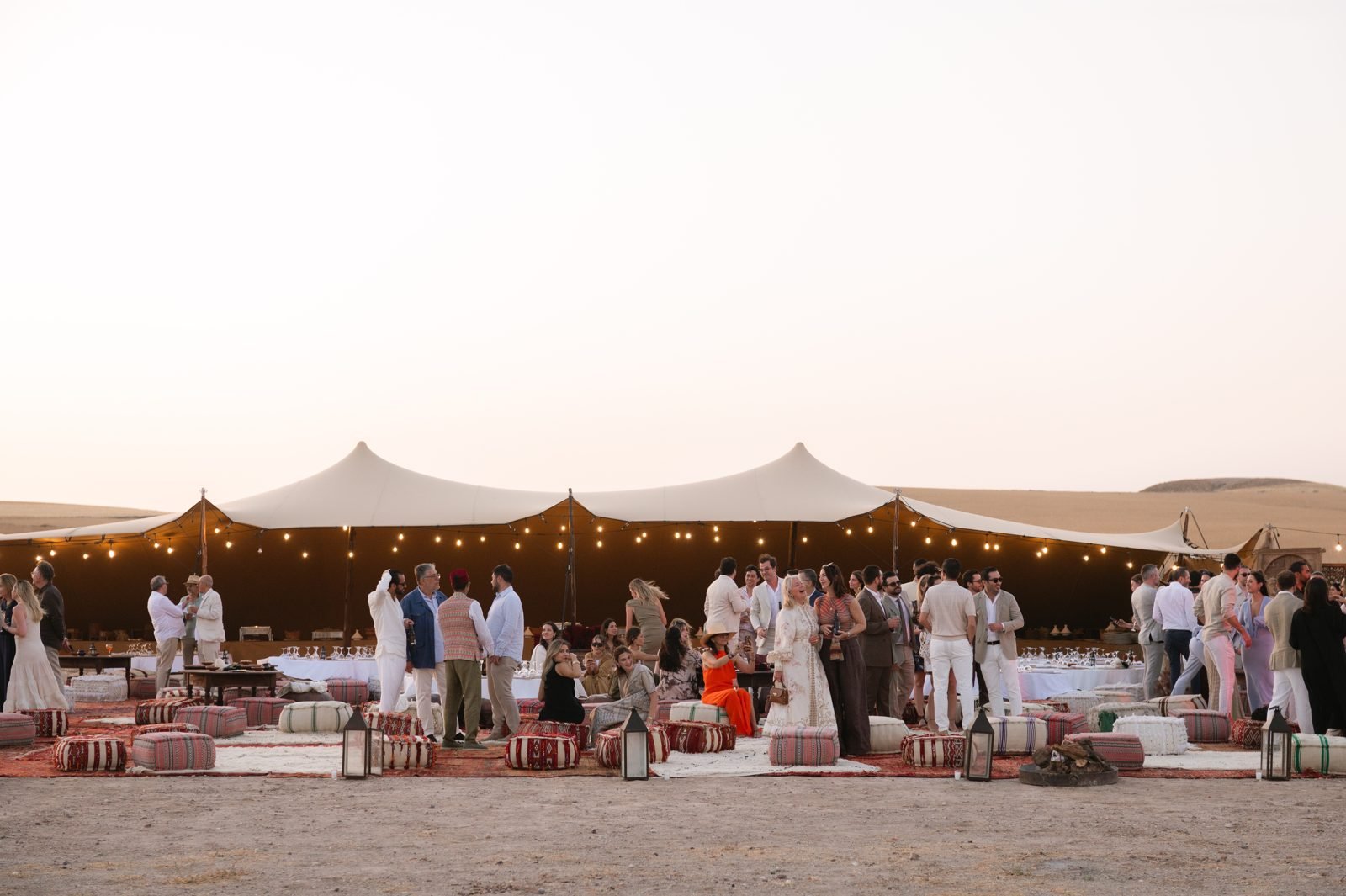
Thirty minutes from the city, and nothing at all
The Agafay is a stone desert, not a sand one. It begins about forty minutes south-west of Marrakech and it looks, at first sight, like the surface of somewhere else: pale rock, low hills, no vegetation to speak of, and the High Atlas standing along the whole southern horizon. There is no dune landscape here, for that you drive eight hours to Merzouga. What the Agafay offers instead is emptiness within reach of a city, and for a wedding that combination is almost impossible to find anywhere else.
It has become, over the last decade, the setting that international couples ask for most often. A wedding planner in Marrakech will usually have an opinion about that, and the opinion is generally the same: it is extraordinary, and it is harder than it looks.
What makes it worth the difficulty
Three things. The first is the light. With no trees and no buildings, the sun goes down across an open horizon and the hour before it is unlike anything the city can give you. The second is the silence, genuine, total silence, which guests who live in cities find physically startling. The third is the sky. There is no light pollution. On a clear night guests will see more stars than most of them have seen in their lives, and it will be the thing they mention first when they get home. No wedding planner in Marrakech will talk you out of wanting it; the conversation is about what it costs to do properly.
What the photographs do not tell you
The Agafay has no infrastructure. That single fact governs everything. There is no mains power, no mains water, no permanent kitchen, no shelter that was not put there for your event. Every camp you have seen in a photograph was built, and will be taken down again.
This means a build of two to three days before the celebration and a day of clearing after it. It means generators sized for a band and a kitchen, not for fairy lights. It means water trucked in. It means a plan for what happens if the wind rises, because it does, and a structure that is beautiful in still air can become a problem in twenty minutes.
It also means the temperature swing is severe. A day that reaches thirty-two degrees will drop to twelve after dark, and further in winter. Guests who have dressed for a desert in the imagination rather than the real one will be cold by ten in the evening. Braziers, blankets and a warning in the invitation are not decorative touches; they are the difference between a night people remember fondly and one they endure.
Getting a hundred and fifty people there
The approach roads are unpaved for the last stretch. This is fine for a four-by-four and awkward for a coach, and it is the logistical question that decides the shape of the evening. Guests must be moved out in a convoy, and moved back again late at night, in the dark, on a track.
The alternative is that they sleep there. Several camps offer accommodation, and a wedding that ends with everyone staying is a fundamentally different event from one that ends with an hour of minibuses, better, usually, and considerably more expensive.
Whichever you choose, the transport plan is not a detail to be settled in the final week. It determines the end time, the drinks policy, the staffing and the cost. Planning a wedding in the Agafay without resolving it early produces a celebration that runs beautifully until eleven and then falls apart.
One night, or the whole thing
The structure that works best for most couples is not a desert wedding but a wedding with a desert night in it. The welcome evening in the citythe ceremony and dinner in a riad or a palace, and then one night, usually the last, in the Agafay, under the stars, with a fire.
It gives guests the contrast, which is the real luxury: the density of the medina and then the absolute emptiness, within the same three days. And it puts the most demanding logistics into a single night rather than spreading them across the whole celebration.
The honest summary
The Agafay is the most beautiful setting available near Marrakech and the least forgiving. Everything that a permanent venue provides by existing has to be created, transported, powered and then removed. Done properly it is unforgettable. Done from a distance, on the assumption that a desert camp is simply a venue with a view, it is where a celebration goes wrong.
If it is what you want, and it is worth wanting, engage a wedding planner in Marrakech who has built in the Agafay before, in the season you have chosenand ask them what went wrong the last time. The useful answer is a long one.