
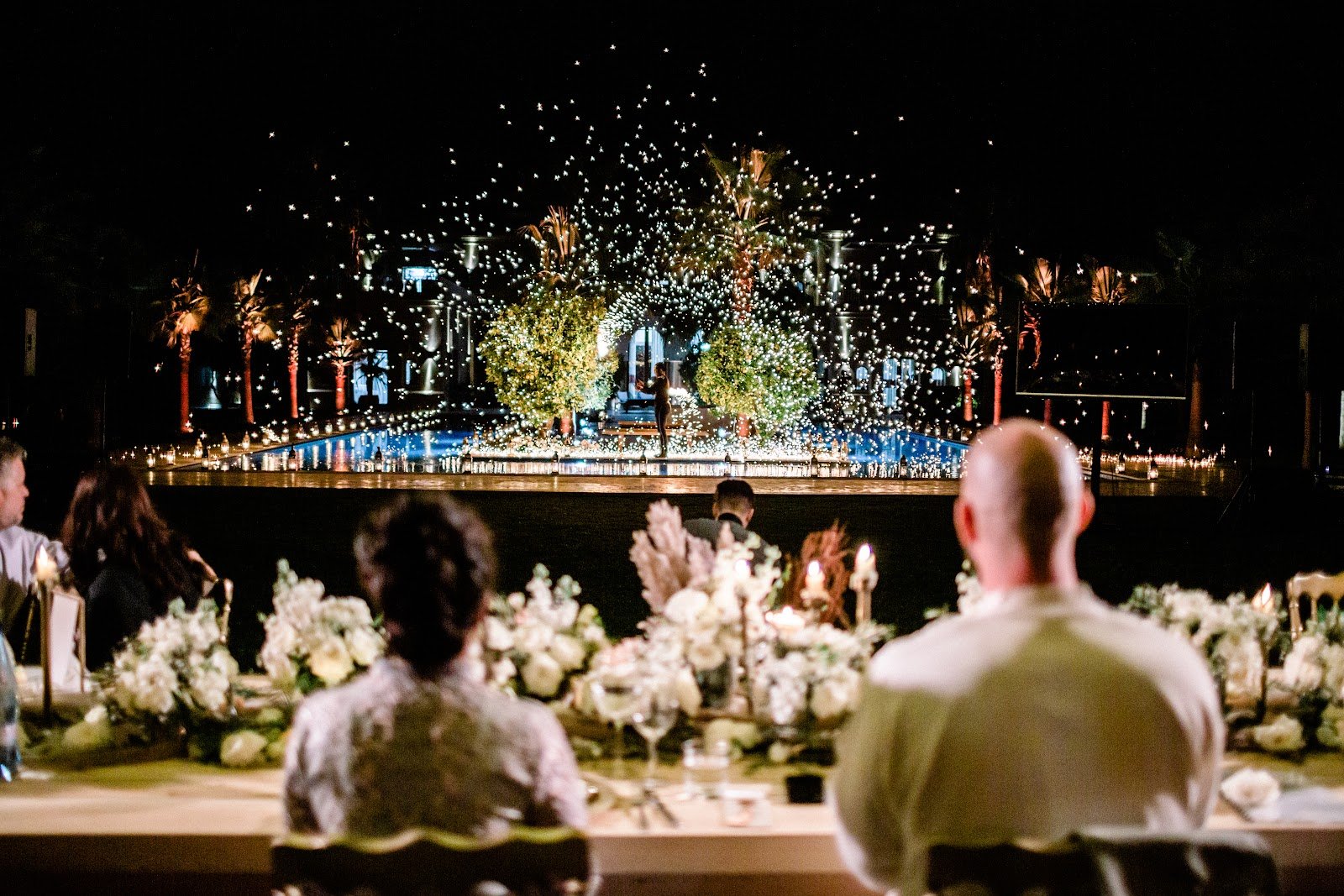
The hours nobody plans and everybody remembers
Ask guests a year later what they remember of a wedding and they will rarely describe the ceremony. They describe the moment the music changed. Almost every wedding planner in Marrakech has watched the same thing happen: a carefully designed day, and then a twenty-minute stretch late in the evening that nobody scripted and everybody talks about.
Music is where that stretch comes from. And in Marrakech there is more to work with than in almost any city on earth, which is both the opportunity and the problem.
Start with the shape of the night
A Moroccan wedding evening has four movements, and each wants a different sound. Arrival and drinks want something present but unobtrusive, an oud, a small string group, something that fills a courtyard without asking to be listened to. Dinner wants the volume to come down, not up; the most common mistake at this hour is music loud enough to make a table of eight shout at each other.
The third movement is the pivot, the fifteen or twenty minutes between the last dish and the first dance. This is where the evening is won or lost. And the fourth is the long tail, midnight to three, when the group has thinned to the people who genuinely want to be there.
What the city offers
The dqqa Marrakchia is the pivotmore reliably than anything else. Hand drums and clay pots, played by a group that moves through the seated guests rather than performing at them. It does not require anyone to know the music. Within five minutes people who were sitting are standing, and the room has changed state.
Gnaoua belongs later. It is hypnotic, spiritual in origin, built on the guembri and iron castanets, and it does not work as background. Given to the late hours and to an audience that has chosen to stay, it produces something no playlist can.
Chaabi is the popular music of Moroccan celebration, this is what a Moroccan family would actually dance to, and a good chaabi band will read a mixed international room and adjust in a way that a DJ working from a set cannot.
And then there is the DJ, who most couples want and should have, but later than they imagine. The error is to hand the whole evening to a DJ at nine o’clock. The better structure gives the live musicians the first half of the night and the DJ everything after midnight.
The constraint nobody mentions until it is too late
Sound after a certain hour is regulated, and the rules differ by venue, by neighbourhood, and by whether the property has neighbours at all. A riad inside the medina, a palace in the Palmeraie and a camp in the Agafay are three entirely different situations.
This is the single most common late discovery in a Marrakech celebration: a couple who have planned dancing until three at a property where amplified sound stops at midnight. The conversation that prevents it happens months earlier, with the venue and sometimes with the local authority, and it is precisely the sort of unglamorous groundwork that a Marrakech wedding planner is engaged to have already done.
Technical things that matter more than they should
Outdoor sound behaves differently at nine in the evening than it did at four in the afternoon, because the air is cooler and the wind has dropped. A system tested in daylight will not sound the same when it matters. Test at the hour you will use it.
Power is the other one. Desert camps and private gardens frequently run on generators, and a generator sized for lighting will not carry a band. This is a calculation, not a hope.
And finally: where the musicians stand. Sound travels differently in a riad courtyard, where hard walls throw it back, than it does under open sky where it simply disappears. The same band, moved six metres, is a different band. Positioning them is a judgement call, made on site, and it is one of the quieter skills a wedding planner in Marrakech brings to a build.
One piece of advice
Do not programme the last hour. Choose the musicians, set the constraints, decide when the DJ takes over, and then leave the final stretch of the night alone. The moment your guests will describe a year from now is one that has to be allowed rather than arranged.