
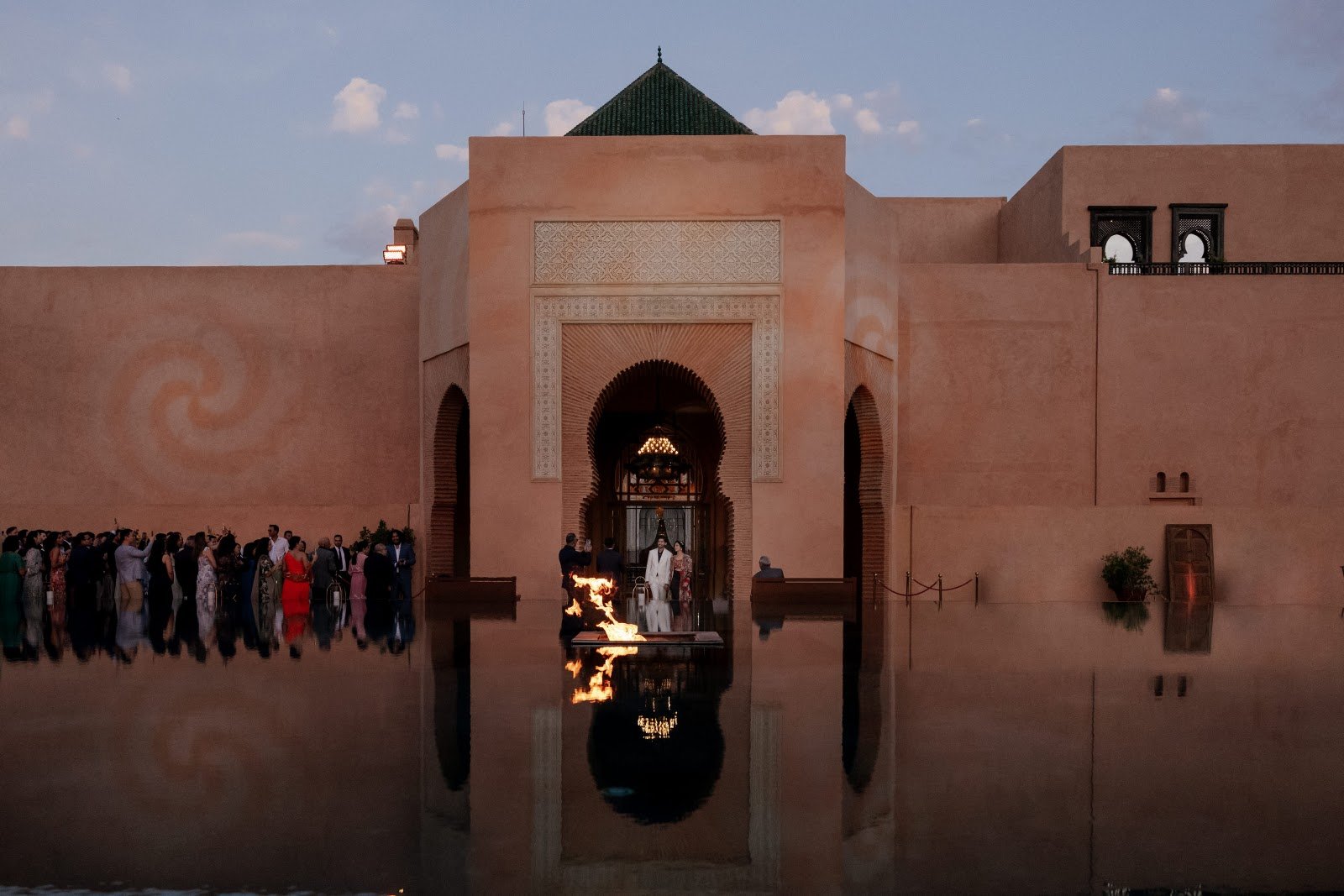
The evening that decides the rest
Every wedding has a moment when the guests stop being a list of names and become a group. At a local wedding it happens somewhere around the second drink. At a destination wedding, where two hundred people have arrived from a dozen countries and most of them know fewer than ten of the others, it does not happen by itself.
The welcome evening exists to make it happen. It is the least formal event of the three days and, in the experience of most people who plan weddings here, the one with the largest effect on everything that follows. A wedding planner in Marrakech will often spend more thought on this night than on the dinner that comes after the ceremony, because the ceremony dinner only has to be good, the welcome evening has to work.
What it is for
Three things, in order of importance.
It dissolves the journey. Guests arrive across a window of fifteen hours, in varying states of exhaustion, having navigated an airport in a language most of them do not read. What they need is not an event but a room that is already warm when they walk into it.
It introduces the country. For many guests this is their first hour in Morocco. Whatever happens in that hour sets what they expect of the next three days. Mint tea poured properlywarm bread, the smell of charcoal, lanterns rather than spotlights, guests who arrive apprehensive about an unfamiliar place tend to stop being apprehensive here, and every subsequent event is easier for it.
And it mixes the room. The bride’s university friends and the groom’s cousins will otherwise spend three days in separate groups. Tonight is the only opportunity to prevent that, and it has to be engineered without anyone noticing it is being engineered.
The design decisions that do the work
No seating plan. This is the single most effective choice and the one couples resist most. A seating plan on the first night locks people into the group they arrived with. Low seating, cushions, several small clusters rather than one long table, and guests will sort themselves.
No speeches. Not one. The temptation to say a few words to everyone is strong and should be resisted entirely; there are two more evenings for that.
Food that grazes. Shared plates arriving continuously rather than courses arriving together. It means there is no moment at which everyone is seated and the conversation freezes into table units.
Music underneath, not over. An oud, a small group, something that makes the silence comfortable without requiring attention. The dqqa and the loud percussion belong to the following nights.
And a clear end. Guests who have been travelling need permission to go to bed. An evening that trails off until two leaves half the group exhausted for the wedding itself.
Where to hold it
A riad courtyard is the classic answer and usually the right one. The walls hold warmth into the evening, the scale is intimate, and the sound of a courtyard makes conversation easy in a way an open garden does not. For larger groups, a palace garden works if it is broken into zones rather than left as one open expanse, a hundred and eighty people spread across a lawn do not become a group, they become several.
What rarely works is a hotel function room, and what never works is the same venue you are using for the wedding dinner. The contrast between the nights is part of what makes each of them land. Choosing the pair of venues, rather than each one separately, is how a wedding planner in Marrakech approaches the question.
The thing to spend on
If the budget is tight, this is the evening to protect. It is cheaper than the wedding dinner by a wide margin and it returns more. A welcome evening that works turns two hundred strangers into a wedding. One that does not leaves you spending the following two days trying to achieve the same thing with speeches and seating charts.
Most of what makes it work is not expensive. It is the pouring of the tea, the temperature of the courtyard at nine, the decision to leave the room unstructured, the judgement about when to let people go to bed. These are small things, and they are exactly the things that a Marrakech wedding planner is paid to have thought about before you arrive.