
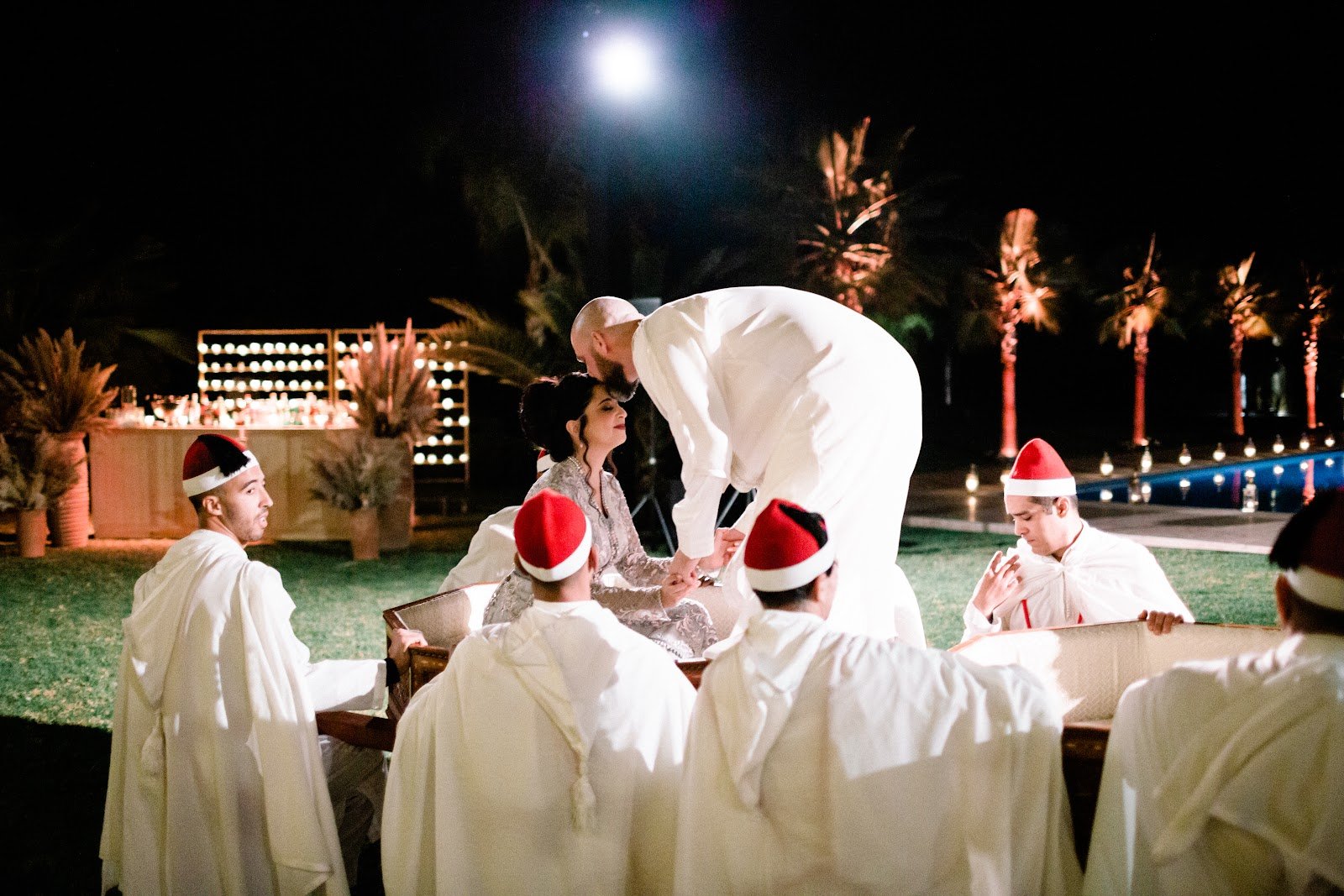
Why one day is rarely enough
Almost nobody who marries in Marrakech marries for a single afternoon. Guests have flown four, eight, sometimes fourteen hours. They have taken days off work. To bring people that far and then hand them one dinner is to waste the distance they travelled. The three-day celebration is not an indulgence here; it is the shape the geography imposes.
What follows is how those three days are usually built. It is not a template, every wedding planner in Marrakech will tell you that the best celebrations break the pattern somewhere, but it is the underlying structure, and understanding it makes every other decision easier.
Day one: the welcome
The first evening exists to dissolve the journey. Guests arrive across a long window, some at dawn, some at midnight, jetlagged and uncertain. What they need is not a formal event but a room that is already warm when they walk into it.
The most successful welcome evenings are the least structured. Low seating, food that can be grazed rather than served in courses, musicians playing quietly enough that conversation is possible. No speeches. No seating plan. People find each other, or they do not, and both are acceptable. The point is that by the time everyone goes to bed, the group has begun to feel like a group.
This is also the night to let Morocco introduce itself. Mint tea poured from height, warm bread, lanterns, the smell of charcoal. Guests who arrive nervous about an unfamiliar country tend to stop being nervous here, and everything afterwards is easier for it.
Day two: the ceremony and the dinner
The central day is the one everyone pictures, and the one where the schedule matters most. The single decision that governs it is the hour of the ceremony, and that hour is set by the light.
In Marrakech the last ninety minutes before sunset are unlike anywhere else: the walls go amber, then gold, then a colour that has no name. A ceremony placed inside that window gives you photographs you cannot buy at any other time of day. Place it two hours earlier and you have harsh overhead sun; place it later and you are lighting faces artificially. Getting this right is one of the small, unglamorous things a Marrakech wedding planner is really for.
After the ceremony comes the gap, drinks, movement between spaces, the part guests remember as effortless and which is in fact the most carefully built hour of the day. Then dinner, long and lateand then the shift into music. Moroccan celebrations do not end at midnight. Plan for two in the morning and be pleasantly surprised.
Day three: the descent
The third day is the one most often underestimated and most often loved. A late brunch, a pool, no obligations. Some couples add an excursion, the medina, a garden, the mountains, but the best version is usually the simplest: food available for four hours and nowhere anyone has to be.
This is when the actual friendships form. The guests who only met at the welcome evening sit together for three hours with nothing to do. Families that have been polite become familiar. If you cut a day from a three-day wedding, do not cut this one.
What the structure is hiding
Behind those three days sits a fourth, invisible one: the build. A desert camp takes two days to raise and a day to clear. Flowers arrive the morning of. Sound is tested the night before, when the wind behaves differently than it will at nine the following evening. Permissions for music past a certain hour are secured weeks earlier, not on the day.
Guests never see any of it, and that is the intention. But it is why planning a wedding in Marrakech from another country, over email, tends to produce a schedule that reads beautifully and collapses on contact with the actual site.
The one thing to decide early
Before venues, before dates, decide how many nights you are asking your guests to stay. Everything downstream follows from that number: which venues can hold the group, how the budget divides, whether the desert is one night or the whole celebration, how much of the city people will actually see.
Three nights is the number that works for most. It is the first thing a wedding planner in Marrakech will ask you to settle, because nothing else can be priced until it is. Two feels rushed for a journey of that length. Four asks a great deal of people with jobs and children. If you are unsure, choose three, and give the third one away entirely, no plan, no schedule, nothing but breakfast that lasts until the afternoon.